Event 1
Woodleigh Common Hallowe’en party
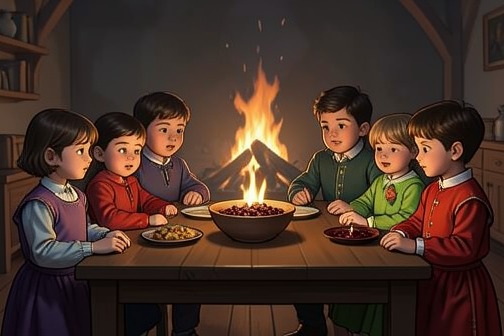
The [Woodleigh Common Hallowe’en party](entity:event-recall-event-woodleigh-common-hallow-ecfd9fab52b9), also called the Eleven Plus party, is [Rowena Drake](entity:character-recall-character-rowena-drake-4320206b70aa)’s well-orchestrated gathering at [Apple Trees](entity:location-recall-location-apple-trees-8dd0a069a637) for children around the age of eleven. Its cheerful programme gives a murderer cover for taking [Joyce Reynolds](entity:character-recall-character-joyce-reynolds-323a6f541e04) away from the other guests, while a staged vase accident later supplies an innocent-looking explanation for the water on the killer’s clothes. The party’s orderly surface and its lethal interruption become inseparable in [Hercule Poirot](entity:character-recall-character-hercule-poirot-16ed38cee024)’s reconstruction of Joyce’s death.
## Occasion and setting
Rowena Drake describes the gathering as an Eleven Plus party rather than a Hallowe’en party, though she acknowledges that it is one in spirit. The label fits the intended age group: most of the children are leaving [The Elms](entity:location-recall-location-the-elms-70e8ee5a0af4) to attend other schools. [Elizabeth Whittaker](entity:character-recall-character-elizabeth-whittaker-d5f7f6cb5467), a local schoolteacher who is particular about accuracy, immediately challenges Rowena’s wording, a small exchange that sets the party’s managed informality against her insistence on precise terms.
The event begins at half past seven. [Ariadne Oliver](entity:character-recall-character-ariadne-oliver-fa78f34dbffd) has initially felt that she does not want to attend, but she admits that the party is a success once it is underway. Arrivals are punctual, and the evening is described as running smoothly. Red and blue lights line the stairs, yellow pumpkins are displayed in profusion, and the children arrive carrying decorated broomsticks for a competition. The festive details are not incidental decoration: they help make a crowded, moving gathering in which guests shift from room to room and attention repeatedly turns toward the next activity.
## Programme and party games
Rowena announces a sequence of entertainments: judging the broomsticks, cutting a flour cake in the small conservatory, bobbing for apples with partners listed on a notice, dancing, a visit by the girls to the small study to receive mirrors, supper, Snapdragon, and prize-giving. During the dancing, the lights go out at intervals and the children change partners. The programme makes movement and temporary separation part of the evening’s ordinary rhythm.
The broomsticks are miniature, and their decoration is generally of modest quality. Rowena jokes privately that this makes the competition easier to judge, since she can arrange for children unlikely to win elsewhere to receive a prize. The evening’s planned generosity is therefore slightly managed, but the party otherwise proceeds according to its schedule. Supper includes iced cakes, savouries, prawns, cheese, and nut confections, which the children eat enthusiastically.
The final entertainment is Snapdragon. The children are called across from the pantry after the prizes have been presented. In the dining room, a green baize cloth covers the table, and a large dish of raisins is brought out flaming after brandy has been poured over them. The children crowd forward to snatch the burning fruit, shrieking and laughing when their fingers are burned. The flames gradually die, the lights come up, and the party ends. Elizabeth Whittaker later describes the dish as more associated with Christmas festivity than with Hallowe’en; within the party, however, it is the climactic spectacle.
## Joyce Reynolds’s disappearance
After Snapdragon, the guests go home. Only then do the adults realize that Joyce Reynolds cannot be found. They call her name and search, while her mother becomes annoyed and supposes that Joyce has gone off alone because she felt tired or ill. The ordinary explanations offered in the first confusion of a child’s absence briefly obscure the more serious possibility: Joyce has been murdered.
Ariadne Oliver later identifies the end of Snapdragon as the likely time of the crime. Hercule Poirot’s account makes the timing more precise. While the guests are gathered in the dining room for the flaming raisins, Rowena takes Joyce to the library. As hostess, she can invite a child to accompany her without provoking suspicion; Joyce, for her part, has no reason to distrust her. Rowena then holds Joyce’s head under water in a full bucket. The child’s struggle splashes water onto the murderer, creating a practical problem that will shape the deception surrounding the killing.
## The wet-clothes alibi
Hercule Poirot treats water as the decisive clue. Anyone who had held a vigorous child under water would be likely to get wet, so the murderer needed a plausible explanation for wet clothes. Rowena supplies one with a large vase of mixed autumn leaves and flowers, filled with water, which she carries onto the first-floor landing. She waits there until Elizabeth Whittaker leaves the hot Snapdragon room and comes into the hall.
Whittaker’s account preserves the details that make the accident credible. Rowena pauses at the angled turn of the staircase, holding the awkward, apparently water-filled vase against herself while reaching for the rail. She looks down toward the hall and the library end rather than at the vase. Then she starts as though startled, lets it go, and the vessel overturns as it falls. Water streams over her; the vase smashes on the hall floor. Rowena and Whittaker pick up the flowers and pieces while Rowena laments the loss of the vase. The staged mishap both wets Rowena in public and gives Whittaker the impression that she has seen someone emerging from the room in which a murder has taken place.
## What the party conceals
Whittaker accepts the apparent explanation at face value, but when she tells [Miss Emlyn](entity:character-recall-character-d72a776c2dbd) about the incident, Miss Emlyn recognizes the significance of the water and urges her to report it to Hercule Poirot. The vase episode thus changes meaning: what appeared to be an accidental interruption becomes evidence of deliberate preparation. Poirot connects it to the bucket, the likely splashing, the library, and Rowena’s need for a witness to her supposed accident, identifying Rowena as Joyce’s murderer.
The party’s final image—the children reaching eagerly for burning raisins—stands beside the concealed killing that takes place under cover of the same gathering. Its games, room changes, and crowded climax provide the opportunity; its hostess’s visible, apparently unfortunate accident supplies the alibi. Joyce had never actually seen a murder, although Rowena believed someone might have witnessed her and [Michael Garfield](entity:character-recall-character-michael-garfield-6ac34b095726) killing [Olga Seminoff](entity:character-recall-character-dfb42e8242b9) in [Quarry Wood](entity:location-recall-location-quarry-wood-11ce9bf2a72b). That mistaken belief explains why Joyce was targeted and makes the party’s apparent success a cover for violence rooted in an earlier crime.
Event 2
Murder of Joyce Reynolds
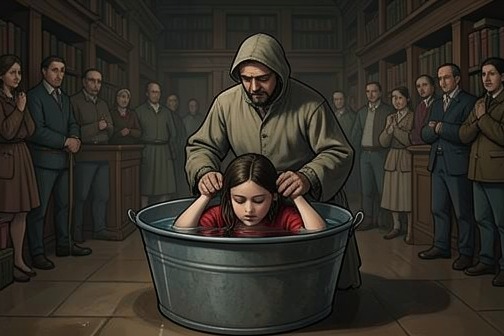
The [Murder of Joyce Reynolds](entity:event-recall-event-murder-of-joyce-reynold-6e0ff690337c) takes place during the Snapdragon at the [Woodleigh Common Hallowe’en party](entity:event-recall-event-woodleigh-common-hallow-ecfd9fab52b9), when [Rowena Drake](entity:character-recall-character-rowena-drake-4320206b70aa) lures Joyce into the library and drowns her in a bucket of water. Its decisive significance lies in the connection between two supposed acts of witnessing: Rowena kills Joyce to prevent her revealing a murder, but Poirot establishes that Joyce had never witnessed one. The water that made the killing physically unavoidable also becomes the clue to Rowena’s staged explanation for her wet clothes.
## Background and Disappearance
[Ariadne Oliver](entity:character-recall-character-ariadne-oliver-fa78f34dbffd) recalls that the party’s final activity was Snapdragon, a Christmas-associated game in which guests snatched raisins from a dish of burning brandy. Afterward, people went home, and Joyce could not be found. The search initially produced the ordinary explanations of a tired or unwell child leaving by herself, but her mother was annoyed that Joyce had not left word. The uncertainty ended when they found her in the library.
The murder was bound to the game’s setting and its equipment. Joyce had been bobbing for apples in a large galvanized bucket nearly full of water. Someone forced her head beneath the surface and held her there until she drowned. Oliver dwells on the weight of the bucket, contrasting it with the plastic one that might have tipped over; the heavy vessel stays put while the child struggles. The scene is not a death by some distant or elaborate method, but a killing carried out at close quarters, in the very apparatus of a party game.
## The Killing and Its Immediate Stakes
Oliver’s account places the murder at the point when the party breaks up. Poirot asks whether Joyce really saw a murder earlier or merely believed she had seen one. Oliver now thinks the claim was true, recalling that Joyce had insisted vehemently that she had seen it happen. At the time, however, Oliver had dismissed the girl as someone dressing up a vague memory to make it sound exciting. Joyce’s insistence changes the meaning of her death: Oliver comes to believe that the killing makes sense only if Joyce was a witness to another murder.
That inference gives the case its urgent causal logic. As Poirot observes, the killer must have been among the people at the party and must also have been present earlier that day, when Joyce spoke about what she had seen. He describes the drowning as an ugly, hurried murder: whoever felt threatened struck as soon as it was possible. Oliver argues that Joyce would not have made her claim if the murderer had been in the room with her when she spoke. Poirot agrees that she saw a murder but not the murderer’s face, leaving the identity of the earlier crime and the person who feared discovery to be worked out.
## Water as Clue and Cover
The reconstruction turns on a physical consequence of the drowning. Anyone holding a vigorous child’s head down in a full bucket would be splashed and soaked. Therefore, the murderer would need an innocent-looking reason to be wet. Poirot connects that necessity to the vase [Elizabeth Whittaker](entity:character-recall-character-elizabeth-whittaker-d5f7f6cb5467) saw Rowena carrying on the staircase: it was large, awkward, and, as Elizabeth supposed, heavy with water.
Elizabeth’s recollection supplies the apparently accidental scene. The Snapdragon room had become hot, so she came into the hall. Rowena emerged from the first-floor lavatory with a vase of autumn leaves and flowers, paused at the staircase, and looked across the hall toward the library door. As she negotiated the turn in the stairs, the vase fell, spilling water over her and smashing on the hall floor. Rowena and Elizabeth gathered the broken pieces and flowers, while Rowena lamented the loss of the vase. What looked like an unfortunate mishap gave Elizabeth a witnessable explanation for Rowena’s wetness—and the impression that Rowena had seen someone coming from the library.
Poirot’s solution recasts the fall as deliberate staging. Rowena had taken Joyce away from the crowded dining room and into the library, where Joyce would have no reason to suspect her hostess. After drowning the girl, Rowena needed someone to see her drenched and accept an innocent cause. She waited on the landing with the water-filled vase, then pretended to start, releasing it so that it flooded her as it crashed below. Elizabeth took the incident at face value; when she later told [Miss Emlyn](entity:character-recall-character-d72a776c2dbd), Miss Emlyn recognized its importance and urged her to tell Poirot. The vase’s shattered remains thus serve two purposes in the explanation: they disguise the source of Rowena’s wet clothes and make the disguise memorable to a witness.
## Revelation and Significance
Poirot identifies Rowena as Joyce’s murderer through the contrast between the necessary wetness of the killer and the contrived accident that accounts for it. The chain of reasoning joins the bucket, the water on the staircase, Elizabeth’s observation, and Rowena’s attention toward the library. The vase is not merely a decorative object involved in an accident; its water provides the cover the killer needs, while its fall helps establish the false story of what Rowena saw.
The final reversal is that Joyce’s alleged knowledge was not what Rowena believed it to be. Rowena had long suspected that someone was present in [Quarry Wood](entity:location-recall-location-quarry-wood-11ce9bf2a72b) when she and [Michael Garfield](entity:character-recall-character-michael-garfield-6ac34b095726) killed [Olga Seminoff](entity:character-recall-character-dfb42e8242b9). Joyce’s claim to have seen a murder seemed to confirm the danger of a witness, and Rowena acted on that fear. But Poirot concludes that Joyce had never seen any murder committed at all. Joyce is killed because Rowena mistakes a claim for proof; the lie, or apparent lie, becomes lethal not through the truth it contains but through the fear it awakens. In retrospect, the Snapdragon’s playful apple-bobbing has become a mechanism of death, and the water that drowned Joyce also exposes the murderer.
Event 3
Janet White’s murder
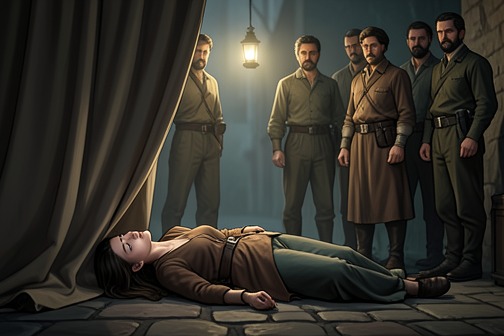
[Janet White’s murder](entity:event-recall-event-janet-white-s-murder-e0cdcae3d439) is an unsolved case from [Woodleigh Common](entity:location-recall-location-woodleigh-common-a9ebaec8a6d9) that becomes significant when [Hercule Poirot](entity:character-recall-character-hercule-poirot-16ed38cee024) considers whether [Joyce Reynolds](entity:character-recall-character-joyce-reynolds-323a6f541e04) may have witnessed it as a child. The possibility links the killing of a local teacher to Joyce’s later claim that she had seen a murder, though the available evidence does not establish that she did.
## Background and Investigation
[Janet White](entity:character-recall-character-janet-white-6307ab1edb55), about twenty-four years old, shared a flat with fellow teacher [Nora Ambrose](entity:character-recall-character-nora-ambrose-9b58c8f58130). She was found strangled on a footpath that served as a shortcut between the schoolhouse and her home. According to Nora, Janet had sometimes been nervous about a man with whom she had ended a relationship a year earlier; he had sent her threatening letters. Neither Nora nor the police established his identity or whereabouts. Investigators questioned several young men and asked others to assist with their inquiries, but found insufficient evidence to bring a case against anyone. The killer was never identified, leaving the murder unresolved.
## The Possible Witness
The murder acquires renewed importance when Hercule Poirot looks for an earlier killing that Joyce Reynolds, then a child, might have seen. Joyce had claimed before witnesses that she had seen a murder some years before. Poirot considers Janet White’s case a better fit than Joyce’s own recent murder: Janet was a teacher whom Joyce might have known, and the child could have witnessed a confrontation without understanding that it was lethal. The possibility remains a hypothesis, not a confirmed account of what Joyce saw.
The timing supports Poirot’s line of inquiry. Janet was killed two and a half years earlier, when Joyce would have been about ten or eleven. Poirot reasons that a child might initially mistake an adult encounter for something less serious, then understand its meaning only later, as she grew older. The delayed recognition gives Joyce’s childhood claim a possible connection to a murder that had remained unexplained.
## The Case’s Unresolved Context
[Miss Emlyn](entity:character-recall-character-d72a776c2dbd) identifies Janet as one of her teachers, about twenty-four years old, and describes her as emotionally vulnerable. Janet was walking home from the school one night; whether she was alone was uncertain. Miss Emlyn says the killer was never discovered, despite police inquiries among several young men, and considers the failure to resolve the case unsatisfactory.
[Elizabeth Whittaker](entity:character-recall-character-elizabeth-whittaker-d5f7f6cb5467) adds that Janet and Nora Ambrose were close friends and that the killing took place in a lane near [Quarry Wood](entity:location-recall-location-quarry-wood-11ce9bf2a72b). Nora was so upset that she left the school and took another post in the north of England. Her departure underscores that the unsolved case affected those around Janet as well as the investigation. When Poirot asks whether the police ever solved it, Whittaker confirms that they did not; the murder therefore remains both a past crime and a possible source of Joyce’s later knowledge.
## Investigative Significance
Poirot’s thick black tick beside Janet White’s name turns an unresolved file into a working lead: familiarity with the victim, he reasons, could explain how Joyce Reynolds might have witnessed a killing without recognizing it as one at the time. [Elspeth McKay](entity:character-recall-character-elspeth-mckay-7d9782a6f76a) challenges the direction of that reasoning, urging attention to the child murdered in Woodleigh Common only days earlier rather than to a possible victim from the past. Their disagreement leaves Janet’s case suspended between two roles—as a crime still lacking a solution and as a possible explanation for Joyce’s claim, which the investigation has not verified.
## Narrative Role and Evidentiary Limits
Janet White’s case functions as a test of how a child’s partial perception might acquire meaning later: Poirot treats Joyce Reynolds’s claim as a clue whose significance may have emerged only with maturity. Yet the inquiry supplies no confirmation that Joyce witnessed Janet’s death, and Elspeth McKay’s objection keeps the possibility from becoming a settled explanation. The case therefore remains unresolved on two levels: its perpetrator is unknown, and its connection to Joyce’s memory is conjectural.
Event 4
Death of Mrs Llewellyn-Smythe
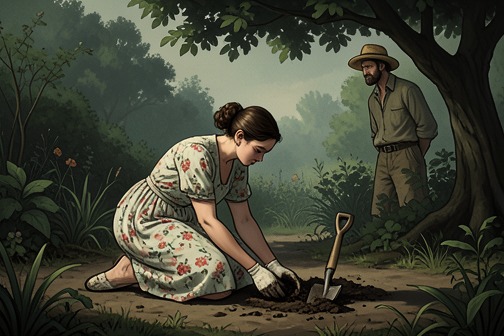
[Death of Mrs Llewellyn-Smythe](entity:event-recall-event-death-of-mrs-llewellyn-1bcc1a389ca3) is the apparently natural death that sets a consequential inheritance mystery in motion. Her known heart condition, strenuous gardening, and sudden collapse seemed to explain what happened; no inquest was held. Yet the disputed codicil associated with her death, and the contrasting accounts of how it was made and witnessed, made the settlement of her estate a source of suspicion and a continuing complication for [Hercule Poirot](entity:character-recall-character-hercule-poirot-16ed38cee024)’s investigation.
## Background and Circumstances
[Mrs Llewellyn-Smythe](entity:character-recall-character-mrs-llewellyn-smyth-a32f9941e8a3) was a wealthy widow whose late husband had been a shipbuilder. When her health failed, she returned from living abroad to be near her nephew and niece, Mr and Mrs Drake, and bought [Quarry House](entity:location-recall-location-quarry-house-db1e89bac0af). Its disused quarry offered an opportunity for an ambitious garden: she spent thousands of pounds transforming it into a sunk garden, employing a landscape gardener to design it. Gardening was not merely an adornment to her life. She pursued it passionately despite medical advice to avoid overexertion, a choice that later made a sudden death after working outdoors seem medically plausible.
She had a heart condition and was regularly attended by [Dr Ferguson](entity:character-recall-character-dr-ferguson-a199cd5423c7). In the account given to Poirot, she came up from doing things in the garden one day breathing heavily, said she was very tired, and went to lie down on her bed. She never woke. The compressed sequence—from exertion outdoors to rest indoors and death—was compatible with the explanation accepted at the time, though the suddenness of the end stood out. [Elspeth McKay](entity:character-recall-character-elspeth-mckay-7d9782a6f76a) understood that Dr Ferguson had been at least slightly surprised, apparently expecting Mrs Llewellyn-Smythe to live longer. That surprise did not, by itself, overturn the natural explanation: she had a serious heart condition and was known not to follow instructions to take things easily.
## The Natural-Cause Ruling and Its Limits
[Superintendent Spence](entity:character-recall-character-superintendent-spen-5266f42f6fae) described the death as unexpected in its timing but not as a cause for suspicion. It was treated as cardiac failure, or a related heart condition, and nobody questioned that it resulted from natural causes. An inquest was never considered. Thus the official account rested on a familiar combination of prior illness, strenuous activity, and collapse at home; no inquiry at the time established a criminal cause.
Later discussion raised the possibility that [Joyce Reynolds](entity:character-recall-character-joyce-reynolds-323a6f541e04) might have heard something suggesting that [Olga Seminoff](entity:character-recall-character-dfb42e8242b9) had given Mrs Llewellyn-Smythe medicine that tasted different or seemed bitter. This was put forward as a hypothetical possibility, not as evidence that the death had been caused by poison. The contrast matters: the death had been accepted as natural, and the available account supplies no proof that the medicine was altered. The question enlarges the field of suspicion around the household without resolving the cause of death or displacing the original medical explanation.
## The Codicil and the Disputed Inheritance
The death became entangled with a remarkable change in the distribution of Mrs Llewellyn-Smythe’s wealth. Her earlier wills had followed a settled pattern: charitable bequests and legacies to old servants, with the bulk of her fortune going to her nephew Hugo Drake and his wife, her niece. If one of them died before her, the other was to inherit. She had also provided for the landscape gardener, leaving him the bungalow she had built for as long as he wished to live there, with an income intended to maintain [Quarry Garden](entity:location-recall-location-quarry-garden-3503f17931d8) and allow the public to visit it.
The alleged final codicil departed sharply from that pattern. Said to have been made about three weeks before her death, it was not prepared by her long-standing solicitors, [Fullerton, Harrison and Leadbetter](entity:organization-recall-organization-fullerton-harris-5e976f206ce5). Instead, it was presented as a document in her own handwriting, leaving the residue of her considerable fortune to Olga Seminoff in gratitude for her care and affection. It retained some charitable bequests but omitted the old servants’ legacies. Because the change came so late and so decisively redirected the estate, it prompted questions about undue influence and whether Mrs Llewellyn-Smythe’s judgment had been impaired. According to Superintendent Spence, however, the lawyers identified the document as a forgery before those broader challenges went forward.
The handwriting evidence gave the forgery a specific opportunity and a specific weakness. Mrs Llewellyn-Smythe disliked typewritten personal letters and often had Olga write them, sometimes imitating her employer’s handwriting and signing her employer’s name. Olga therefore had considerable practice in producing writing that looked like Mrs Llewellyn-Smythe’s. But handwriting experts judged the probate codicil to bear only a faint resemblance to the original. Proceedings were being prepared to contest it; during the legal delay before a case could come to court, Olga lost her nerve and disappeared, leaving some of her belongings behind. Her disappearance added a personal and practical mystery to the disputed estate, but it did not itself establish that she had forged the document or had any part in Mrs Llewellyn-Smythe’s death.
## A Second Document and the Aftermath
The documentary history became more complicated when [Harriet Leaman](entity:character-recall-character-5052a5710492) recounted witnessing a different act. On a day when Mrs Llewellyn-Smythe was unwell, Olga was asked to leave the room. Mrs Llewellyn-Smythe then told Harriet and a young garden assistant, Jim, that she was writing on a paper and wanted them to witness both the writing and her signature. Harriet remembered seeing her use her usual scratchy pen, write several lines, and sign her name; Mrs Llewellyn-Smythe then asked both witnesses to write their names and addresses. Harriet also recalled turning as she left because the door did not latch properly, though the account available here does not establish what she saw through the door or the contents of the writing.
When Poirot checked with Mr Fullerton, he learned that the codicil submitted for probate had not been witnessed by Harriet Leaman. Its witnesses were Mary Doherty, a former servant who had since died, and James Jenkins, who had gone to Australia. The distinction exposed a problem that a simple forged-document account could not settle: the probate codicil was identified as false, while Harriet’s recollection suggested that Mrs Llewellyn-Smythe may also have executed a genuine codicil. The testimony did not, on its own, establish that the witnessed document was the same as the forged instrument, or disclose its terms. It instead reopened the question of what Mrs Llewellyn-Smythe had actually written and how the competing papers related.
## Narrative Significance
In Poirot’s early inventory of possible victims, Mrs Llewellyn-Smythe was entered as a suggested victim, even though the reported ruling was natural death. That provisional attention reflects the way the investigation treats an apparently closed case: wealth and a disputed inheritance invite scrutiny, but suspicion must be distinguished from proof. The death’s narrative force lies less in a demonstrated murder than in the unstable evidence that follows it—the suddenness that prompted questions, a forged codicil with an apparent beneficiary, the missing Olga, and testimony pointing to another document.
The contrast between the accepted cause of death and the contested paperwork also keeps the inquiry from collapsing separate issues into one. The forged codicil supplied grounds for legal suspicion about the inheritance; it did not prove that Mrs Llewellyn-Smythe was killed. The possibility of altered medicine remained speculative; it did not overturn the natural-cause ruling. By preserving those distinctions while bringing the documents and witnesses into the investigation, Poirot turns a settled death into an evidentiary puzzle whose unresolved details bear on the wider chain of events surrounding Olga Seminoff and Joyce Reynolds.
Event 5
Forgery of Mrs Llewellyn-Smythe’s codicil
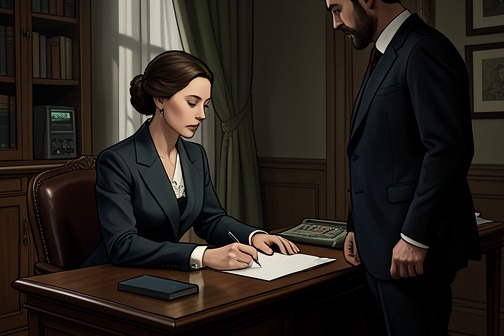
The [Forgery of Mrs Llewellyn-Smythe’s codicil](entity:event-recall-event-forgery-of-mrs-llewelly-7a4b781f6640) is the attempted diversion of a substantial inheritance to [Olga Seminoff](entity:character-recall-character-dfb42e8242b9), an employee who had practised copying her employer’s handwriting. Its detection seemed at first to make the case straightforward: handwriting experts identified the probate document as forged, and Olga vanished as a legal challenge approached. Testimony about a separate signing, however, raised a crucial distinction between having witnessed [Mrs Llewellyn-Smythe](entity:character-recall-character-mrs-llewellyn-smyth-a32f9941e8a3) write a document and establishing that the document submitted for probate was genuine.
## The expected inheritance and the disputed change
For years, Mrs Llewellyn-Smythe’s wills followed a stable pattern. After bequests to charities and legacies to old servants, the bulk of her fortune went jointly to her nephew, Hugo Drake, and his wife, who was also Mrs Llewellyn-Smythe’s cousin and niece. If either spouse died first, the survivor was to receive the money. Her lawyers, [Fullerton, Harrison and Leadbetter](entity:organization-recall-organization-fullerton-harris-5e976f206ce5) of [Medchester](entity:location-recall-location-medchester-a8a0cad37e85), had handled her legal affairs over many years, and changes to the arrangements had generally involved charities or legacies rendered void by a beneficiary’s death.
The disputed document departed sharply from that history. Made about three weeks before Mrs Llewellyn-Smythe’s death, it was described as a handwritten codicil, not one drawn up by her usual firm. It reduced the number of charitable bequests, left no legacies to the old servants, and assigned the entire residue of her considerable fortune to Olga in gratitude for her devoted service and affection. The size of the change, as well as its beneficiary, made the document strikingly unlike the previous pattern. The family might have argued that Mrs Llewellyn-Smythe’s mental balance had been disturbed or that she had been unduly influenced, but the lawyers’ discovery of forgery took precedence over those possible challenges.
## How the forgery became possible
Olga had been asked to write many of Mrs Llewellyn-Smythe’s personal letters. Her employer disliked typed letters to friends and sometimes instructed her to copy the handwriting closely and sign Mrs Llewellyn-Smythe’s name. This gave Olga repeated practice not merely in imitating the appearance of the writing but, on some occasions, in reproducing the signature. According to the account given by [Elspeth McKay](entity:character-recall-character-elspeth-mckay-7d9782a6f76a), that familiarity suggested to Olga that she could create a document that would pass as her employer’s work.
The attempt did not withstand scrutiny. The lawyers obtained handwriting experts, whose examination showed that the codicil produced for probate bore only a faint resemblance to Mrs Llewellyn-Smythe’s hand. It was not a convincing imitation to trained examiners, and her own firm detected the problem quickly. The case therefore turns on two different kinds of evidence: Olga’s opportunity and practice, which explain how she could attempt the forgery, and the expert comparison, which established that the probate document was not Mrs Llewellyn-Smythe’s writing.
## The challenge and Olga’s disappearance
Once the forgery was detected, proceedings were being prepared to contest the document. The legal process had not yet reached court; there was an interval before the challenge could be heard. During that delay, Olga lost her nerve and disappeared. She left one day with some of her belongings behind, before the lawyers could take proceedings against her. Elspeth speculated that she might have returned to her own country, changed her name, or gone to friends, but these were possibilities, not confirmed outcomes.
Olga’s disappearance left the fraud exposed without completing the story of her whereabouts. It also followed from the particular weakness of the scheme: the document’s intended effect depended on its acceptance as Mrs Llewellyn-Smythe’s own codicil, yet expert scrutiny could test that claim. A document could alter the apparent destination of an estate, but its effect remained vulnerable to proof about how it had been written and authenticated.
## [Harriet Leaman](entity:character-recall-character-5052a5710492)’s account of a signing
The apparent resolution became less secure when Harriet Leaman described an earlier visit to Mrs Llewellyn-Smythe’s room. On a day when Mrs Llewellyn-Smythe was unwell, Harriet and a young garden helper, Jim, were called inside. Papers lay on the desk. Mrs Llewellyn-Smythe sent Olga out, saying she must not be involved in that part of the matter, then told the two visitors that she was writing her will and wanted them to witness what she wrote and her signature.
A piece of blotting paper covered the upper part of the page, but the lower part was visible. Harriet recalled Mrs Llewellyn-Smythe writing two or three lines with the scratchy pen she habitually used, signing her name, and asking Harriet and Jim to write their names and addresses beneath. Mrs Llewellyn-Smythe said they had seen her write and sign. Harriet initially thought little of the incident, though she wondered about it; as she was leaving, she turned her head while pulling the door shut, which did not always latch without a firm pull. Her account establishes what she remembered seeing and being asked to do, but the obscured page means it does not by itself identify the document’s full contents or settle its legal status.
## The witness discrepancy and unresolved question
After checking with Mr Fullerton, [Hercule Poirot](entity:character-recall-character-hercule-poirot-16ed38cee024) reported that the forged codicil produced for probate had not been witnessed by Harriet Leaman. Its named witnesses were Mary Doherty, a former servant of Mrs Llewellyn-Smythe who had recently died, and James Jenkins, who had gone to Australia. Harriet had described a signing witnessed by herself and Jim; the probate document, by contrast, carried the names of Mary Doherty and James Jenkins. The difference makes witness identity a separate issue from the handwriting evidence and from the fact that Harriet recalled witnessing a signature.
The distinction prevents the evidence from collapsing into a simple choice between a forged document and a valid one. Harriet’s memory indicates that she and Jim saw Mrs Llewellyn-Smythe write and sign something, while expert examination shows that the codicil submitted for probate was forged and its witness list did not match Harriet’s account. Poirot consequently suggests that a real codicil may also have existed. The possibility complicates the apparent chain of events without proving what the other document said, whether it was completed or legally effective, or how it related to the forgery. The case’s central uncertainty is thus documentary as well as personal: a forged codicil is established, but the remembered signing opens the question of whether it was the only codicil.
Event 6
Murder of Charlotte Benfield
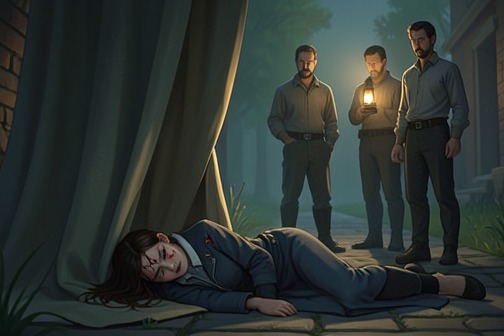
The [Murder of Charlotte Benfield](entity:event-recall-event-murder-of-charlotte-ben-4cc6329bbe1a) is an unresolved killing recalled during [Hercule Poirot](entity:character-recall-character-hercule-poirot-16ed38cee024)’s review of earlier victims with [Superintendent Spence](entity:character-recall-character-superintendent-spen-5266f42f6fae). Charlotte, a sixteen-year-old shop assistant, was found on a footpath near [Quarry Wood](entity:location-recall-location-quarry-wood-11ce9bf2a72b); although two young men came under suspicion, the investigation produced no evidence sufficient to identify either as her killer.
## The Case and Its Suspects
When Poirot wrote down the names of earlier victims, Charlotte’s case prompted Spence to set out what the police had learned. She had suffered multiple head injuries and was found on a footpath in a field not far from [Woodleigh Common](entity:location-recall-location-woodleigh-common-a9ebaec8a6d9), near Quarry Wood. The murder had taken place eighteen months earlier. The evidence presented in this recollection establishes the circumstances and location of her death, but does not describe the precise sequence of events or identify a weapon.
The two men suspected of the killing had each walked out with Charlotte from time to time. Both were frightened during the police inquiry, told lies, and contradicted themselves. Their accounts weakened their credibility, but suspicion did not become proof: Spence regarded either man as a possible killer while acknowledging that the police had no evidence on which to prosecute. Their cases also differed in character and in the support offered for their whereabouts that evening.
Peter Gordon was twenty-one, unemployed, and had failed to keep one or two previous jobs. Spence described him as lazy and quite good-looking. He had been placed on probation once or twice for minor thefts, but had no known history of violence. He associated with a group Spence regarded as likely young criminals, while generally managing to avoid serious trouble. Gordon’s alibi came from friends Spence considered disreputable; it was not convincing, but the police could not disprove it.
Thomas Hudd was twenty and worked in a stationer’s shop. He stammered, was shy and neurotic, and had hoped to become a teacher but had not been able to qualify. His widowed mother was described as doting and as keeping him close, while discouraging relationships with girls. Spence considered jealousy a possible motive because Charlotte had, in his account, played Hudd up, but there was no prosecutable evidence. Hudd’s mother supplied his alibi, insisting he had been at home with her throughout the evening; no one could place him elsewhere or near the scene. Her assurance could not be independently disproved on the information Spence had.
## Place in the Victim Review
Charlotte’s case enters the narrative not through a scene of the killing but through Hercule Poirot’s methodical review of names with Superintendent Spence. Poirot’s notebook is already headed “Victims”; after noting [Mrs Llewellyn-Smythe](entity:character-recall-character-mrs-llewellyn-smyth-a32f9941e8a3) as a suggested first entry, he records the other names Spence supplies and pauses over Charlotte’s. Spence’s answer turns the name into a compact case history: her age and work, the head injuries, the footpath near Quarry Wood, and the two men whose uncertain accounts never yielded proof. Poirot’s questions move from the suspects’ identities and characters to the timing and location of the murder, fixing it eighteen months earlier in a field near Woodleigh Common. This retrospective framing makes the case part of an accumulated record of deaths under examination, while preserving its central gap: suspicion remains, but no evidence resolves who killed Charlotte.
## The Language of Suspicion
Spence’s dry correction of the phrase “assisted the police in their inquiries” gives the case a guarded, procedural tone: the suspects spoke, but their lies and contradictions did not amount to a solution. The distinction matters. Their conduct damages the credibility of their accounts without establishing which man, if either, committed the murder. In Spence’s recollection, the investigation stops at that boundary between suspicion and proof, leaving the case unresolved rather than converting an unconvincing alibi into evidence of guilt.
## The Boundary Between Suspicion and Proof
The case remains unresolved because the inquiry could not turn suspicious conduct, possible motives, or imperfect alibis into evidence establishing guilt. The two men’s contradictory accounts made them difficult to trust, but did not distinguish one as the killer; likewise, the jealousy Spence considered possible in Hudd’s case remained conjectural. Gordon’s associates could not provide an alibi the police found persuasive, yet they supplied one the police could not disprove. These competing uncertainties leave Charlotte’s murder suspended between plausible suspicion and an unproved accusation, a limit that Poirot’s victim-by-victim review records rather than resolves.
Event 7
Joyce Reynolds's Halloween-Party Murder
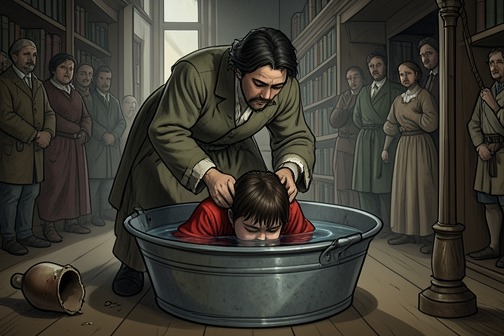
[Joyce Reynolds](entity:character-recall-character-joyce-reynolds-323a6f541e04)’s Halloween-Party Murder is the deliberate killing of Joyce Reynolds by [Rowena Drake](entity:character-recall-character-rowena-drake-4320206b70aa) during the [Woodleigh Common Hallowe’en party](entity:event-recall-event-woodleigh-common-hallow-ecfd9fab52b9). [Hercule Poirot](entity:character-recall-character-hercule-poirot-16ed38cee024) explains that Joyce was drowned in a full bucket in the library, then shows how Rowena used a deliberately broken, water-filled vase to make the wetness that exposed the crime appear accidental. The case turns on a mistaken assumption about who had witnessed an earlier murder: Joyce had heard about it from [Miranda Butler](entity:character-recall-character-miranda-butler-5b044d661ef4), while Miranda was the person who had actually seen it.
## Causes and the mistaken witness
Rowena’s fear reached back to [Quarry Wood](entity:location-recall-location-quarry-wood-11ce9bf2a72b), where she and [Michael Garfield](entity:character-recall-character-michael-garfield-6ac34b095726) had killed [Olga Seminoff](entity:character-recall-character-dfb42e8242b9). She had always suspected that someone was present and might have seen the killing. Joyce’s claim that she had witnessed a murder therefore seemed to Rowena like confirmation of that danger. Poirot’s reconstruction establishes the irony: Joyce had seen no murder. Miranda, who often visited Quarry Wood to observe birds and squirrels, had witnessed Olga’s death and told her best friend about it. Joyce repeated Miranda’s story, probably to impress [Ariadne Oliver](entity:character-recall-character-ariadne-oliver-fa78f34dbffd), but Rowena mistook the boast for evidence that Joyce herself knew the truth.
The distinction between the two girls changes the meaning of the crime. Joyce was not killed because she could identify what she had seen; she was killed because Rowena believed she could. The false claim was dangerous precisely because it carried a truth Rowena did not know: someone really had witnessed the killing of Olga, but it was Miranda, not Joyce.
## The killing at the party
Poirot describes the death as intentional, not an accident: Joyce’s head was held beneath water in a full bucket until she died. The party’s bustle provided Rowena with an opportunity. When the guests crowded into the dining room for the Snapdragon, a Christmas-associated party game involving flaming raisins and brandy, Rowena took Joyce with her into the library. Joyce had no reason to suspect her hostess, and Poirot’s account makes the invitation itself part of how Rowena brought the child within reach.
The water was both the means of death and the clue that eventually exposed the killer. A vigorous child struggling in a bucket would splash water over the person holding her down. As Poirot reasons, whoever killed Joyce would necessarily have become wet; Rowena therefore needed an innocent explanation for being soaked at the party.
## The vase and the staged explanation
[Elizabeth Whittaker](entity:character-recall-character-elizabeth-whittaker-d5f7f6cb5467)’s account supplied the scene that made the water clue legible. The Snapdragon room had grown hot, so Whittaker came out into the hall. She saw Rowena emerge from the lavatory on the first-floor landing carrying a large vase of autumn leaves and flowers. The vase seemed heavy, presumably because it held water. Rowena paused at the staircase, adjusted her hold, and looked down toward the hall and the library door.
Rowena then appeared to start, released the vase, and let it fall down the stairs. It overturned, drenched her, and smashed on the hall floor. Whittaker helped her gather the broken pieces and flowers. The incident gave Rowena a visible, apparently accidental reason to be wet—and, according to Poirot, led Whittaker to believe she had noticed someone coming from the room where the murder had occurred. Rowena’s performance turned a consequence of the killing into an alibi witnessed by someone else.
## Discovery and significance
The clue was not simply that there had been water: water in the bucket was expected. Poirot’s decisive question was why the killer would also have been wet, and what event could explain that wetness innocently. Whittaker’s observation, initially a report about a broken vase, became significant when [Miss Emlyn](entity:character-recall-character-d72a776c2dbd) recognized what it implied and urged Whittaker to tell Poirot. Once he connected the vase to the necessary splashing, Poirot concluded that Rowena had killed Joyce and staged the accident to conceal it.
The murder brings the two crimes in Quarry Wood and at the party into a single chain of fear and misrecognition. Rowena’s earlier killing of Olga supplied the secret she wanted to protect; Joyce’s borrowed story made her seem exposed; and the wet clothes that should have betrayed Rowena were disguised by the broken vase. The explanation also restores Miranda’s place in the chain of events: she was the actual witness, though Joyce’s reputation for lying initially obscured the truth she had passed on.
Event 8
Murder Case of Olga Seminoff
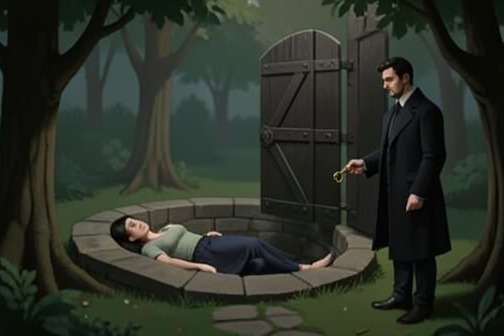
[Murder Case of Olga Seminoff](entity:event-recall-event-olga-seminoff-e345df021ffa) is the concealed killing at the heart of the later crimes in the novel: [Rowena Drake](entity:character-recall-character-rowena-drake-4320206b70aa) and [Michael Garfield](entity:character-recall-character-michael-garfield-6ac34b095726) kill Olga, an au pair who knows about a hidden codicil, and hide her body in a wishing well in [Quarry Wood](entity:location-recall-location-quarry-wood-11ce9bf2a72b). The murder is not only an attempt to remove a witness. A forged document is arranged to make Olga appear responsible for forgery, so that her disappearance can be read as evidence of guilt rather than as a crime. That deception sets in motion a chain of suspicion, concealment, and further killing.
## Background and Motive
Olga works as an au pair for [Mrs Llewellyn-Smythe](entity:character-recall-character-mrs-llewellyn-smyth-a32f9941e8a3) and knows about the codicil. Mrs Llewellyn-Smythe has hidden the original document, leaving the conspirators to build their plan around a forgery and the likelihood that Olga will be blamed for it. The plan depends on suspicion, not a formal prosecution: the forged document appears to benefit Olga, and evidence that she copied her employer’s handwriting could make the accusation seem credible. If Olga disappears, people may conclude that she was a forger and may even suspect that she helped bring about her employer’s sudden death.
[Lesley Ferrier](entity:character-recall-character-lesley-ferrier-d37c87134dc3) is drawn into the document scheme. Poirot concludes that Lesley had no arrangement or love affair with Olga, despite Michael Garfield’s suggestion to that effect, and believes Michael paid him to produce a similar forged document. The forgery was intended to be so obviously false that it would immediately arouse suspicion. In that design, Lesley’s role helps create the appearance of a plot around Olga, while the hidden original and Olga’s knowledge make her a danger to the people arranging it.
Michael’s approach to Olga combines an appeal to her affections with calculated pressure. He is courting her, urging her to keep quiet and not tell her employer, while speaking of possible marriage in the future. Poirot’s reconstruction reveals the gulf between that promise and the conspirators’ actual purpose: Michael and Rowena have already marked Olga as the victim whose removal would allow them to obtain the money they wanted. The marriage prospect is therefore part of the means by which they seek her silence, not evidence of a genuine future they intend to share with her.
## Killing and Concealment
The precise circumstances and method of Olga’s killing are not specified in Poirot’s account. He states that she died on a suitable occasion and identifies Rowena and Michael as the people who killed her. The distinction matters: the later discovery establishes that the death was murder, but the evidence does not describe how the killing itself was carried out. Nor does the knife found in the well establish the method of Olga’s murder; Poirot connects that weapon to the wounds suffered by Lesley Ferrier.
After the murder, Olga’s body is hidden in a wishing well in Quarry Wood, on an incline not far from Michael Garfield’s cottage. Her disappearance leaves the forged-codicil story available to explain her absence and places the real crime out of sight. The well consequently serves both as a physical hiding place and as the buried point at which the forgery plot and the later investigation meet.
Rowena and Michael fear that someone may have been in the wood and witnessed either the killing or the disposal of the body. They do not know who that person might be. When nothing immediately follows, the absence of consequences reassures them; they are lulled into security and proceed with their plans without haste. In retrospect, their uncertainty is crucial: the murder has left them exposed to a witness, even though they do not yet know the witness’s identity.
## Discovery and Reconstruction
The body’s discovery first reaches the people around the investigation as news of a positive result. Elspeth asks whether the body found in the well is the missing au pair, and the answer is that it seems to be. She wonders whether the girl threw herself in; the response rules out suicide and confirms that she was knifed and murdered. This exchange turns the well from a possible clue into the location of a murder victim, though the full connection to the forged codicil and the later killings still has to be explained.
Poirot’s reconstruction of the hiding place grows from a sequence of clues rather than from knowledge of the original killing. He already knows that Olga has disappeared and that her body must be somewhere in the neighbourhood, but he does not initially know where. [Miranda Butler](entity:character-recall-character-miranda-butler-5b044d661ef4)’s interest in a wishing well, and Michael’s refusal to take her there, directs his attention to that location. [Mrs Goodbody](entity:character-recall-character-fc9d291bb3c5)’s recitation of the nursery rhyme [Ding dong dell, pussy’s in the well](entity:expression-recall-expression-ding-dong-dell-pus-09a339dbd702) then supplies the decisive association; Poirot becomes sure that the missing girl’s body is in the well. He identifies the site in Quarry Wood, close to Michael’s cottage.
The discovery retrospectively clarifies why the conspirators’ fear of a witness mattered. Poirot reasons that Miranda may have seen either the murder itself or the later disposal of the body. He does not claim certainty about which of the two she witnessed, but the possibility explains the danger Rowena and Michael had tried to anticipate. Their plans had continued because they did not know who, if anyone, had seen them.
## Consequences and Significance
Olga’s murder supplies the concealed history behind the sudden crisis at the [Hallowe'en](entity:time-recall-time-hallowe-en-ba2cd97350f7) party. After years in which Rowena and Michael believe the danger has passed, [Joyce Reynolds](entity:character-recall-character-joyce-reynolds-323a6f541e04) claims that she has witnessed a murder. Rowena takes the claim to identify the unknown person from Quarry Wood and acts quickly. Joyce’s statement is false: she has not witnessed a murder at all. But Rowena does not know that, and her response to the old crime creates another murder and a new trail for Poirot to follow.
The forged-codicil scheme also connects Olga’s fate to Lesley Ferrier’s. The intended accusation against Olga depends on the forged paper, while Poirot concludes that Lesley was paid by Michael to make the document. Lesley is later killed, and the knife found in the well corresponds closely to his wounds. These are distinct crimes and the knife evidence pertains to Lesley, but together they reveal how the original plan’s fabricated story and its surviving evidence continue to expose the people behind it.
Olga’s murder thus functions as both a motive and an unresolved act of concealment. The conspirators intend her disappearance to reinforce a false account of forgery; instead, the body in the well, the rhyme, Miranda’s interest, and the fear of an unknown witness allow Poirot to reconstruct what happened. The crime’s importance lies not in a fully described method of killing, which the account withholds, but in the chain of consequences created by the attempt to bury the victim and the truth with her.
Event 9
Murder Case of Lesley Ferrier

[Lesley Ferrier](entity:character-recall-character-lesley-ferrier-d37c87134dc3)’s murder initially passed for one more stabbing with plausible explanations and too little evidence to settle on a culprit. [Hercule Poirot](entity:character-recall-character-hercule-poirot-16ed38cee024)’s reconstruction makes it part of a larger scheme: Ferrier was paid to forge a codicil that would incriminate [Olga Seminoff](entity:character-recall-character-dfb42e8242b9), then killed to prevent the forgery’s origins from coming to light. The case turns on the difference between what appeared suspicious and what the documents, witnesses, and eventual discovery could actually establish.
## Ferrier’s Background and the Murder
Ferrier was a junior clerk in the [Medchester](entity:location-recall-location-medchester-a8a0cad37e85) solicitor’s office of [Fullerton, Harrison and Leadbetter](entity:organization-recall-organization-fullerton-harris-5e976f206ce5). His employer, Mr Fullerton, had taken him on in the hope of making an honest man of him. Ferrier had a previous forgery conviction, but it was his first offence and he had received a light penalty amid reported extenuating circumstances: people locally spoke uncertainly of either a sick mother or a drunken father. Mr Fullerton believed Ferrier was young and capable, and had warned him against returning to unlawful company.
That warning had a particular edge. Ferrier had become associated with dubious groups and transactions outside the law. [Superintendent Spence](entity:character-recall-character-superintendent-spen-5266f42f6fae) considered gang retaliation a credible explanation for the stabbing: a person entangled with such company might be killed if suspected of informing. The possibility fitted what was known of Ferrier’s associations, but it did not establish who had killed him or why.
Ferrier was knifed one evening. Local opinion held that the police probably knew who was responsible but lacked the evidence needed to prove it. Another account circulating in the area linked him to Sandra, whose husband kept a local pub. The story was that she and Ferrier had been having an affair, that he later took up with another woman, and that Sandra might have resented the change. These were competing explanations, not demonstrated motives; the gang theory and the jealousy story each offered a ready-made account of the killing without exposing its connection to the forged codicil.
## The Forged Codicil and Ferrier’s Part
For many years, [Mrs Llewellyn-Smythe](entity:character-recall-character-mrs-llewellyn-smyth-a32f9941e8a3) had kept to a stable pattern in her will. Her estate went jointly to her nephew, Hugo Drake, and his wife, [Rowena Drake](entity:character-recall-character-rowena-drake-4320206b70aa), who was also Mrs Llewellyn-Smythe’s first cousin and niece. Charitable bequests and gifts to old servants varied, but the residue remained with the Drakes. About three weeks before Mrs Llewellyn-Smythe died, however, a purported handwritten codicil made a striking change: after a smaller number of charitable gifts, it left the residue of her considerable fortune to Olga Seminoff, in gratitude for her service and affection.
The document was unlike the established pattern and was not prepared by the family’s usual solicitors. Handwriting experts found it to be a complete forgery, with only a faint resemblance to Mrs Llewellyn-Smythe’s writing. Olga had often written personal letters for her employer, who disliked using a typewriter, and had practiced copying her handwriting, sometimes even signing her name. That history made Olga an immediately plausible suspect, but it also supplied the means by which suspicion could be directed at her.
The testimony about witnesses sharpened the distinction between a document actually signed before witnesses and the forged paper later produced for probate. [Harriet Leaman](entity:character-recall-character-5052a5710492) recalled being summoned, with a young garden worker, while Mrs Llewellyn-Smythe wrote and signed a document partly covered by blotting paper. Mrs Llewellyn-Smythe asked them to add their names and addresses as witnesses. But when Poirot checked the forged codicil with Mr Fullerton, he learned that its witnesses were Mary Doherty, a former servant who had died, and James Jenkins, who had gone to Australia—not Harriet Leaman. The remembered witnessing of a document therefore did not authenticate the forged codicil or make the two papers the same.
Poirot concluded that Ferrier had been paid to produce a similar forged document, deliberately unconvincing enough to attract scrutiny. The evidence in the case exposed the paper as false; the conspiracy’s purpose, however, was not simply to win Olga’s inheritance through a convincing forgery. The document was meant to make her appear to be the forger. Because it seemed to benefit her, and because she had practiced copying her employer’s hand, the suspicion could be made to look natural.
## A Killing Hidden Among Plausible Motives
Poirot rejected the suggestion that Ferrier’s supposed love affair with Olga explained his involvement. He regarded that story as a fabrication introduced by [Michael Garfield](entity:character-recall-character-michael-garfield-6ac34b095726). In Poirot’s account, Michael paid Ferrier to make the forged codicil, while Michael and Rowena Drake were arranging to remove Olga, who knew about the codicil, and use her as a scapegoat. Olga did not need to be convicted or even prosecuted: it was enough for her to be suspected, and then to disappear, leaving the apparent forgery to stain her reputation.
Ferrier’s murder followed because he could connect the forged document to the people who had arranged it. Poirot identifies the killing as a means of silencing him, not as an unrelated result of gang affiliations or romantic jealousy. The explanation accounts for why the apparent motives were so distracting: Ferrier’s criminal associations and the story about Sandra made his death look like a familiar local crime, while concealing its place in the plan against Olga. The account establishes the purpose of the killing, though it does not specify the identity of the person who physically wielded the knife.
The physical clue emerged from the well in [Quarry Wood](entity:location-recall-location-quarry-wood-11ce9bf2a72b), where Olga’s body had been concealed. The knife found there corresponded closely with Ferrier’s knife wounds. It connected his stabbing to the disposal of Olga’s body and supported Poirot’s reading of the linked crimes. The discovery did not turn every part of the reconstruction into direct eyewitness proof, but it made the supposedly separate deaths harder to treat as unrelated.
## Reassessment and Significance
The case changes meaning as the evidence is reassembled. Ferrier’s first forgery conviction had made him vulnerable to recruitment; his work on the codicil then made him dangerous to the conspirators. The forged document exploited Olga’s genuine familiarity with her employer’s handwriting, while its conspicuous defects and witness discrepancies exposed its falsehood. A document could implicate Olga without being legally or forensically convincing, and a remembered signature witnessed on one occasion could not validate a different paper presented for probate.
The same pattern applies to the explanations of Ferrier’s death. His associations and the story of Sandra were possible leads, but neither accounts for the knife’s connection to Olga’s concealment or for the role Poirot assigns him in making the forged codicil. His murder is thus both a silencing and a misdirection: the conspicuous history of a young clerk with a forgery conviction offered an easy story, while the actual danger lay in the information he carried about a staged inheritance claim. Once the forged paper, Ferrier’s payment, and the well are considered together, his apparently ordinary stabbing becomes an essential link in the plot to frame Olga and secure the estate.
Event 10
Murder Case of Leopold Reynolds

The [Murder Case of Leopold Reynolds](entity:event-recall-event-leopold-reynolds-5ec28ffaa9ab) reveals that Leopold’s death was neither an accident nor an isolated tragedy: someone drowned him to prevent him from speaking about a clue to an earlier murder. The case turns on a withheld witness account, the money Leopold had recently received, and Poirot’s insistence that compassion for the killer cannot replace justice for those still at risk.
## Death in the brook and withheld testimony
Leopold was found dead on a field path after apparently going out of his way, on his return from school, to play in a nearby brook. The account of his death is stark: someone held him down and kept his head under water. Its method recalled the drowning of [Joyce Reynolds](entity:character-recall-character-joyce-reynolds-323a6f541e04), making the two children’s deaths feel like repetitions rather than unrelated misfortunes.
Mrs Drake had seen something connected to the crime but did not tell the police, even after Leopold’s death. She explained that the person she had seen was very young—ten, perhaps eleven—and that she had thought he could not fully understand what he was doing. She hoped he might receive special psychological treatment instead of being sent to the police or to an institution. Her silence was meant, in her view, to protect a child; it also left the person who could identify or expose a murderer unable to speak safely.
Mrs Drake later understood the danger her silence had helped create. She reasoned that Leopold must have seen either the murderer or something that could identify him, and that the murderer had waited until the boy was alone before drowning him. She regretted not speaking to Poirot, the police, or anyone else, recognizing that her confidence in knowing what was best had instead allowed the threat to continue.
## Payment, risk, and the pursuit of justice
Poirot learned that Leopold had recently been unusually flush with money. He treated the payment as evidence that the boy had been bought off: Leopold wanted money, received it, and was then drowned when the opportunity arose. The money changed the significance of the death. It suggested not a random attack but an effort to keep a child silent, and it made the boy’s danger part of a wider pattern in which killing had become a means of security for the killer.
That interpretation sharpened the contrast between compassion for Leopold and responsibility toward the living. [Rowena Drake](entity:character-recall-character-rowena-drake-4320206b70aa) had been overwhelmed by pity for the very young person she believed connected to the earlier crime, and had hoped that treatment might be possible instead of police involvement. Poirot did not dismiss that compassion, but argued that it could do nothing for Leopold after his death. Pursuing justice, he told [Miss Emlyn](entity:character-recall-character-d72a776c2dbd), might instead help keep another child alive by stopping a killer who had struck more than once. He was travelling to [London](entity:location-recall-location-london-420923d4a60a) to persuade others to accept his certainty and discuss how to proceed.
The case’s later solution also shows how the effort to suppress a possible witness grew out of a mistaken belief about what had been seen. Poirot traced Joyce’s murder through water: whoever had forced her head into a full bucket would have been soaked, so the killer needed an innocent explanation for being wet. Rowena had carried a water-filled vase onto the landing and staged its fall in front of [Elizabeth Whittaker](entity:character-recall-character-elizabeth-whittaker-d5f7f6cb5467), giving the witness an apparent reason for her wet clothes while directing suspicion toward someone supposedly leaving the scene. Rowena believed that someone might have witnessed her and [Michael Garfield](entity:character-recall-character-michael-garfield-6ac34b095726) killing [Olga Seminoff](entity:character-recall-character-dfb42e8242b9) in [Quarry Wood](entity:location-recall-location-quarry-wood-11ce9bf2a72b); in fact, Joyce had not seen that murder. The staged accident thus concealed one killing while the fear of exposure helped drive the violence that followed.
## From physical trace to planted alibi
The case’s decisive clue is not simply that water was present, but that the drowning made wet clothing unavoidable. [Hercule Poirot](entity:character-recall-character-hercule-poirot-16ed38cee024)’s question about the water turns an apparently ordinary detail into a test of the killer’s account: someone who held a child’s head beneath the surface of a full bucket would be splashed. The water on the sheet and around the bucket therefore has a double significance, recording the violence while also explaining why its perpetrator needed a separate reason to appear wet.
Elizabeth Whittaker’s account supplies the circumstances that make Rowena Drake’s explanation persuasive at first and incriminating in retrospect. During the Snapdragon, the burning dish of raisins and brandy made the room hot; Whittaker stepped into the hall and saw Rowena pause on the shaped turn of the staircase with a heavy vase of autumn leaves and flowers. Rowena looked across the hall toward the library, shifted the awkward vase, and then appeared to start, releasing it. The vase overturned, water spilled over her, and it smashed on the hall floor. The broken vessel thus gave her wetness a visible, seemingly accidental cause, while her gaze and sudden reaction suggested that she had noticed someone near the library. Poirot’s reconstruction makes the staged mishap legible as an alibi built for a witness: Whittaker’s observation was real, but the meaning Rowena encouraged her to assign to it was false.
## How the case becomes legible
The investigation depends on keeping observation separate from interpretation. Elizabeth Whittaker saw Rowena Drake release the vase, soak her clothes, and break the vessel; that account established what happened on the landing, but not why. Poirot’s reconstruction supplies a test for the explanation: the person who drowned Joyce would have been wet, so the vase’s fall had to account for more than a mishap. Mrs Drake’s silence and Leopold’s recent money then add a further link, suggesting why the boy might have been killed. No single detail carries the whole case. Its force comes from the way a physical trace, a witness’s account, and an undisclosed payment converge, changing the meaning of scenes that first appeared unrelated.
Event 11
Attempted Ritual-Sacrifice Murder at Kilterbury Ring

The [Attempted Ritual-Sacrifice Murder at Kilterbury Ring](entity:event-recall-event-kilterbury-ring-0e6c75b4c52c) is [Michael Garfield](entity:character-recall-character-michael-garfield-6ac34b095726)'s carefully staged attempt to kill [Miranda Butler](entity:character-recall-character-miranda-butler-5b044d661ef4). He turns an ancient stone circle, a golden cup, and Miranda's guilt into instruments of control, presenting murder as ritual; [Nicholas Ransom](entity:character-recall-character-cccf413295da)'s intervention saves her and exposes the connection between the attempted sacrifice and the crimes surrounding [Joyce Reynolds](entity:character-recall-character-joyce-reynolds-323a6f541e04) and the missing au pair.
## Setting and Background
[Kilterbury Ring](entity:location-recall-location-kilterbury-ring-8cb4edd1e09f) is a local beauty spot whose ancient remains are not especially famous. Though the stones had been dismantled many centuries earlier, several tall megaliths still stood as traces of past ritual worship. Miranda admired the place and asked why the stones had been set there. Her companion answered by invoking ritual and sacrifice, introducing the idea that would transform a visit to a historic site into a threat against her life.
The meeting took place in November, when, as Miranda's companion observed, the blackberries were over and the weather kept other visitors away. He waited for the sun to fall directly on a stone and described the moment as wonderful because no one else was likely to be at the Ring. The isolation was not incidental: it left Miranda alone with the man who had brought her there and gave his staged ceremony the appearance of a private, timeless rite.
## The Staged Sacrifice
Michael directed Miranda to a carved double axe on one of the stones, describing it as a sign made by people who had come from Mycenae or Crete hundreds of years earlier. He asked her to put her hand on it and proposed a toast to the past, the future, and beauty. A golden cup was placed in Miranda's hand, and Michael poured a golden liquid from a flask. He told her it tasted of peaches and urged her to drink, then turned her toward the setting sun and instructed her to raise the cup.
Miranda obeyed. One hand remained on the megalith and its partly erased mark; Michael stood behind her. Two figures crept up the slope from below the leaning stone, but those at the summit had their backs to them and did not notice their approach. As Miranda was told to drink to beauty, the attempted killing was interrupted by a voice: “Like hell she does!” A rose velvet coat was thrown over a head, and a knife was knocked from the hand that was rising. Nicholas caught Miranda and dragged her away while the other two struggled.
## Miranda's Understanding of the Threat
Once pulled clear, Miranda did not describe herself as an unsuspecting victim. She said she had understood, in a way, that she was to be sacrificed. She believed Joyce had been killed because of her and asked whether it was therefore right that she should become the victim of a ritual killing. Her response shows how Michael's staging had worked: he had given Miranda's remorse a murderous form, making self-punishment seem to her like a kind of justice.
Nicholas rejected that interpretation and told her that the missing au pair girl had not run away, as people had believed after the forged will. Her body had been found in the well. When Miranda asked whether it was the wishing well she had wanted so badly to find, Nicholas answered that the person who had brought her to Kilterbury Ring was the same person who had put the girl there. The rescue thus brought a concealed crime into the open at the very moment Miranda's own life was saved.
## The Plan and Its Earlier Crimes
Poirot later explained that Michael had planned the scene around Miranda's attachment to ritual and beauty. He had instructed her to tell him if she was leaving [Woodleigh Common](entity:location-recall-location-woodleigh-common-a9ebaec8a6d9) and to meet him at the inn where [Ariadne Oliver](entity:character-recall-character-ariadne-oliver-fa78f34dbffd) and [Judith Butler](entity:character-recall-character-judith-butler-625214ab905f) had lunched. His intended discovery scene was the Ring, with Miranda beside the double-axe sign and a golden goblet at her side: an apparent ritual sacrifice that would disguise a deliberate murder.
The plan also belongs to the wider chain of violence. Michael had killed [Olga Seminoff](entity:character-recall-character-dfb42e8242b9) with [Rowena Drake](entity:character-recall-character-rowena-drake-4320206b70aa), and Rowena feared that someone might have witnessed the killing in [Quarry Wood](entity:location-recall-location-quarry-wood-11ce9bf2a72b). Joyce had not, in fact, seen a murder, but Michael's guilt about the earlier crime helped make Miranda's mistaken belief dangerous. Poirot's account of Joyce's death supplied a separate link: the murderer had needed an innocent explanation for getting wet after holding a struggling child beneath water. Rowena created one by dropping a water-filled vase and letting [Elizabeth Whittaker](entity:character-recall-character-elizabeth-whittaker-d5f7f6cb5467) witness the resulting accident. These earlier crimes explain why Miranda's supposed knowledge and Michael's attempt to silence or frame her could be folded into the artificial sacrifice at the Ring.
## Aftermath and Significance
Michael's ritual construction was undone by the arrival of the rescuers, and Miranda survived. Poirot later pictured Michael dead beside the megalith marked with the double axe, still clutching the golden goblet he had seized and drained when retribution came. The image returns the objects of the staged ceremony to the scene, but reverses their meaning: the would-be director of a sacrifice becomes its dead figure, while his intended victim lives.
The episode contrasts the children's [Hallowe'en](entity:time-recall-time-hallowe-en-ba2cd97350f7) party, with its arranged games and flaming raisins, against Michael's private imitation of ancient ritual. At the party, ritual-like customs belong to communal play; at Kilterbury Ring, Michael uses old symbols to isolate Miranda, teach her to accept a false account of justice, and make a murder appear ceremonial. The double axe, the cup, and the language of beauty are not proof of a supernatural or sacred order. They are props in a plan to turn murder into spectacle and to bend Miranda's guilt toward her own death.
Event 12
Forged-Codicil Plot to Frame Olga
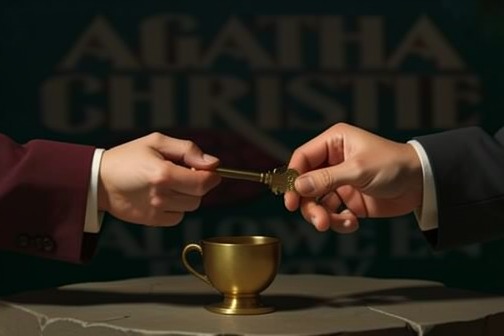
The [Forged-Codicil Plot to Frame Olga](entity:event-recall-event-olga-9c64e9a62231) is a scheme to manipulate an inheritance by making [Olga Seminoff](entity:character-recall-character-dfb42e8242b9) look like the author of a fraudulent codicil. Its central trick depends on two documents being mistaken for one: Poirot distinguishes an apparently genuine codicil that redirected the estate from a conspicuously forged document submitted for probate. The forgery was designed not to survive expert scrutiny, but to cast suspicion on Olga, remove her as a witness, and leave [Rowena Drake](entity:character-recall-character-rowena-drake-4320206b70aa) positioned to inherit under the earlier will.
## The Inheritance and the Two Documents
For many years, [Mrs Llewellyn-Smythe](entity:character-recall-character-mrs-llewellyn-smyth-a32f9941e8a3)’s testamentary arrangements had followed a consistent pattern. Charitable bequests and legacies to old servants might change, but the bulk of her fortune went jointly to her nephew, Hugo Drake, and his wife, Rowena, who was also Mrs Llewellyn-Smythe’s cousin and niece. If either spouse died first, the survivor inherited. That provision gave the old will decisive force once Hugo had died.
The document that first drew attention was presented as a codicil made about three weeks before Mrs Llewellyn-Smythe’s death. Unlike her previous documents, it had not been drawn up by her regular solicitors. It was said to be in her handwriting, reduced the number of charitable bequests, omitted legacies to the old servants, and left the residue of her considerable fortune to Olga in gratitude for her devoted service. The change was so unlike the established pattern that it immediately appeared remarkable.
There was also a separate account of Mrs Llewellyn-Smythe making a document in front of [Harriet Leaman](entity:character-recall-character-5052a5710492) and a young garden worker, Jim. According to Leaman, Mrs Llewellyn-Smythe sent Olga out of the room, covered the upper part of the paper with blotting paper, wrote several lines with her scratchy pen, signed, and asked both witnesses to write their names and addresses. The account establishes that Leaman witnessed a document being written and signed; it does not establish that this was the forged codicil later submitted for probate.
## How the Forgery Created Suspicion
The submitted codicil was not authenticated by Leaman and Jim. When Poirot checked with the solicitor, he learned that its witnesses were Mary Doherty, a former servant who had died, and James Jenkins, who had gone to Australia. That discrepancy matters: a witness’s memory of seeing a document signed cannot by itself establish that the document later offered for probate is the same one.
Handwriting experts found that the submitted codicil bore only a faint resemblance to Mrs Llewellyn-Smythe’s hand and was a complete forgery. Olga nevertheless made a convenient suspect. Mrs Llewellyn-Smythe disliked typewriters and often had Olga write personal letters, copying her employer’s handwriting; on some occasions Olga had even signed Mrs Llewellyn-Smythe’s signature. Her experience supplied a ready-made explanation for the forged writing, and the apparent benefit to Olga made the accusation seem plausible. Earlier discussion of the affair had already raised the possibility that Olga could have produced the document.
The law’s timing helped the scheme. The solicitors identified the forgery quickly, and proceedings were to be taken to contest it, but the usual delay meant that the case would not immediately reach court. During that interval Olga lost her nerve and disappeared. In Poirot’s reconstruction, the conspirators did not need her to be convicted or prosecuted: it was enough for the forged document to make people suspect her. Her disappearance could then be read as further evidence of guilt, while also removing someone who knew about the other codicil.
## The Intended Legal Outcome
The forged document was meant to fail. Because it was so plainly defective, Poirot reasoned, a lawyer would challenge it and handwriting experts would establish its falsity. The challenge would undo the codicil and restore the original will. With Hugo recently dead, Rowena would then receive the fortune as the surviving beneficiary.
This was the plot’s essential legal misdirection. The forgery seemed to be a clumsy attempt to secure the estate for Olga, but its obviousness was useful to the people behind it: its expected rejection would return the inheritance to Rowena. The forgery therefore had a double purpose. It created a conspicuous accusation against Olga while arranging for the earlier disposition, favorable to Rowena, to prevail. The suspicion generated by the document and the inheritance produced by its failure pointed in different directions only if the genuine codicil was overlooked.
## The Genuine Codicil and the Conspiracy
Poirot’s explanation treats the document witnessed by the cleaning woman as a real codicil, distinct from the fake submitted for probate. Its precise contents are not independently established in the account, so his reconstruction remains a surmise: he believes Mrs Llewellyn-Smythe discovered that [Michael Garfield](entity:character-recall-character-michael-garfield-6ac34b095726) and Rowena were having an affair, probably before Hugo died, and reacted by leaving her estate to the au pair girl. He further suspects that Olga told Michael about the change because she hoped to marry him.
On Poirot’s account, Michael and Rowena needed Olga removed because she knew of the genuine codicil. They also needed her to appear responsible for the forgery. Michael allegedly paid [Lesley Ferrier](entity:character-recall-character-lesley-ferrier-d37c87134dc3) to produce a similar document after Mrs Llewellyn-Smythe had hidden the original. Poirot rejects Michael’s account of a love affair or arrangement between Lesley and Olga as an unconfirmed story. Instead, he concludes that Michael was courting Olga, encouraging her to keep quiet with the prospect of a future marriage, while treating her coldly as a person who could be made the scapegoat.
The false accusation was joined to lethal violence. Poirot concludes that Olga was killed once the plot required her silence and that Lesley was killed after his involvement in producing the forgery. Lesley’s stabbing was made to resemble a gang attack or an attack by a jealous woman, but the knife found in the well corresponded closely to his wounds. The document was thus not an isolated fraud: it helped disguise a succession of crimes by making Olga appear to be the dishonest party and Lesley’s death appear to have another explanation.
## Exposure and Significance
Olga’s disappearance did not settle what had happened to her. Poirot knew her body must be hidden nearby but did not initially know where. [Miranda Butler](entity:character-recall-character-miranda-butler-5b044d661ef4)’s questions about a wishing well, and Michael’s refusal to take her there, directed attention to the possibility that the well mattered. [Mrs Goodbody](entity:character-recall-character-fc9d291bb3c5)’s recollection of the nursery rhyme about a cat in a well confirmed Poirot’s suspicion; Olga’s body was found in a well in [Quarry Wood](entity:location-recall-location-quarry-wood-11ce9bf2a72b), on an incline not far from Michael’s cottage. Poirot also considered that Miranda might have witnessed either the murder or the later disposal of the body, while Rowena and Michael feared that someone had seen something without knowing who it was.
The plot’s force comes from the difference between documentary appearance and evidentiary identity. A person may witness a signature without witnessing the signing of the document later produced; a handwriting resemblance may be explained by practice without proving authorship; and a forged instrument can have its intended effect even when it is legally worthless. Here the counterfeit’s failure was part of its design. By disentangling the forged codicil from the genuine one, Poirot reveals how inheritance, suspicion, disappearance, and murder had been arranged around the same deception.